← The library Opening the sample... Get the first 9 minutes of Part 1 free, out of 89 minutes in the full title. It is the same recording. Enter your email and it starts playing right here. That link has expired, or we have already sent you a newer one. Enter your email and we will send you a fresh link. Check your inbox. We sent a link to . Tap it and the sample opens. Nothing there yet? Look in your spam or promotions folder, or send it again. You are in now. Refresh the page and start listening. 0:00 of --:-- This title is in your library. Every chapter is open: tap one and it plays there. Menopause and Desire If your desire has gone silent, or gone strange, or surprised you by coming back stronger, and nobody has explained why, this is where the explaining starts. 30-day money-back guarantee. If it is not for you, write to support within 30 days and you get every cent back.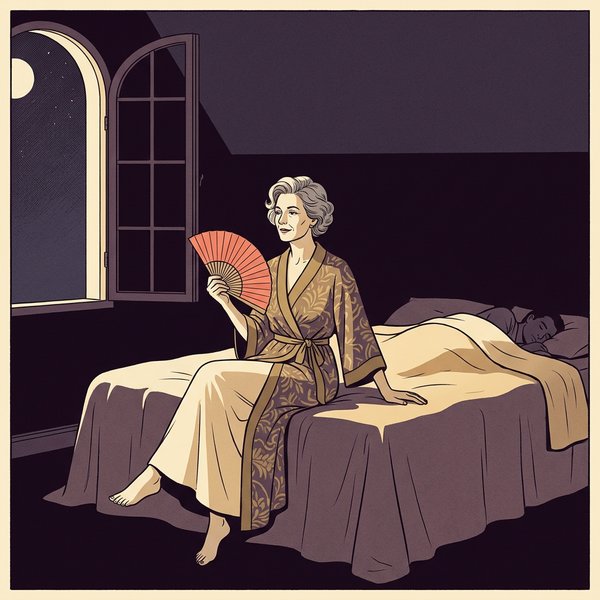 Sociosexuality.org · Audio Menopause and Desire
Part 1 · 44 min What changes in the body
Part 2 · 45 min What changes in the couple
Menopause and desire: what changes for you, and what changes for the two of you
+ VAT where applicable
Nobody told you desire could simply go silent.
You're in bed with a book you aren't really reading, and your partner comes in, kisses your shoulder, stays there a second longer than usual. There's a question in that kiss.
And you feel it, that little drop in your stomach. It's not that you don't love them, because you do. It's that wanting has turned into a stranger lately and you honestly have no idea where it went.
Or maybe it went the other way for you. The change caught you off guard because desire got stronger, not weaker, and now you're wondering why nobody ever told you that was possible.
Or maybe you're the partner in this. You've noticed the distance and you don't want to push, or turn it into something about you, but you miss them and honestly have no idea what you could say that won't land wrong.
The thing about menopause and desire is this.
It happens in your body, and it happens between the two of you. Most of what you've been told doesn't cover either one very well.
Your doctor gets through the basics quickly because the appointment is short. A magazine article is mostly about some product. And a friend tells you it's just part of getting older, then moves on to something else.
So you are left with unspoken questions.
Will this last? Is it me, my hormones, or the two of us? Why does sex feel uncomfortable now when it never used to? Why do some women find they want more in these years rather than less? And after so many years together, how do you and your partner even start that conversation?
There is research on exactly this. The Study of Women's Health Across the Nation, a long-running US study of midlife women, has followed women through these years. Other researchers have studied midlife couples and their sex lives.
That research rarely reaches the bedroom it is about. It sits in journals and reports, written for other researchers, while you lie awake wondering whether the change is in you, in your body, or in the two of you.
So we laid it out clearly, for women going through it and for the people who love them.
What changes after you listen
Once you've listened, what's happening with your desire won't be some mystery you have to carry around by yourself anymore.
You'll finally see what's going on in your body from perimenopause onward, the hormones and the comfort and desire itself, and how they tie together, so the things you're feeling come with a reason you can actually put a name to.
You will also understand something you may never have heard: that for some women, desire rises in these years. If that is you, you will know why. If it is not, you will know that the story of menopause is not one story.
This part is about the couple, and we look at how partners talk about it, or don't, and at what the studies find about sex in midlife couples, so you can see where the two of you fit.
You will come away with words for it. Words that let you say what is happening without apologizing first, and that let a partner ask about it without the question landing like a complaint.
And you'll be able to see each other more fairly, not as one person with a problem and the other one waiting on them, but as two people going through a real change together, each of you coming at it from your own side.
And you will have somewhere to start. Not a script, not a set of rules. Just a few clear things the two of you can try, at your own pace, once you both understand what is going on.
You won't be pushed to want more, or to want less, and we can't promise the past back. What you get is what the research shows, explained warmly, plus some things to try.
Here is some of what you will find out
- What changes in your body from perimenopause onward, and why some of it can start well before menopause itself (Part 1)
- How hormones, comfort and desire connect, explained in plain words (Part 1)
- Why some women notice their desire going up in these years, not down, and what the research has to say about it (Part 1)
- What a long-running US study that followed women through midlife can add to what you thought you knew (Part 1)
- Comfort and desire aren't the same thing, so it helps to pull them apart and look at each one on its own (Part 1)
- Why wanting sex less often doesn't have to mean you love your partner any less (Part 1)
- How to sort out which part is your body and which part is something else, so you can put a name to it (Part 1)
- The questions you may never get to ask a doctor in a short appointment, and what the research has to say about them (Part 1)
- Menopause doesn't go the same way for every woman, and what happens to you may be different from what happened to a friend (Part 1)
- What midlife partners say to each other about wanting sex, and the things that keep that talk from happening (Part 2)
- What the research says about sex in long midlife couples (Part 2)
- The partner who isn't going through menopause is part of this story too, and here's why (Part 2)
- How to talk about desire with someone you've been with for years, without the talk turning into a fight (Part 2)
- What to say when you feel turned down, and what to say to a partner who feels pushed (Part 2)
- How the two of you can stay close when sex has dropped away for a while (Part 2)
- Midlife couples research, and what it might mean for the two of you instead of for the averages (Part 2)
- When the two of you have stopped talking about sex for a long while, here is how to get the conversation going again (Part 2)
- A calmer way to think through what comes next for the two of you (Part 2)
+ VAT where applicable
- 89 minutes of audio in 2 parts
- A printable PDF workbook
- Plays in your browser on any device, signed in
30-day money-back guarantee. If it is not for you, write to support within 30 days and you get every cent back.
What each part gives you
Part 1 · 44 minutes
What changes in the body
This part is about the body, from perimenopause on. You will learn what changes with hormones, what changes with comfort, and what changes with desire itself, and how the three connect. You will hear what the Study of Women's Health Across the Nation, a long-running US study of midlife women, adds to the picture, explained clearly. And you will hear about something you may not expect: why desire rises for some women in these years. Whether your desire has dropped, risen or simply become hard to read, you will come away knowing that what you feel has reasons, and that your story does not have to match anyone else's. That can lift a lot of unspoken worry.
You walk away with
- Hormones, comfort and desire each shift, and each one pulls on the others.
- It begins in perimenopause, earlier than menopause itself
- For some women desire rises in these years
- Clear words for what is happening in your own body
Part 2 · 45 minutes
What changes in the couple
Menopause happens inside a relationship, not to one woman by herself, and this part is about the two of you. It covers how partners talk about desire in these years and what gets in the way of that talk, along with what studies find about sex life in couples at midlife. You will see what tends to change between two people who have been together a long time, and what seems to help them stay close. If you are the partner, it can help you understand what is going on without taking it personally. If you are the one going through it, you get words for what you feel, so you can explain it without apologizing for it. Most couples come away with a calmer way of talking about something that may have gone unspoken between them for a long while.
You walk away with
- Menopause changes the couple, not just the body
- How the two of you talk about it, and what keeps getting in the way
- What the research says about sex in midlife couples
- Shared words to break a long silence
This is for you if…
- you're in perimenopause or menopause and your desire has shifted in ways that don't make sense to you yet
- your desire has gone up rather than down, and you would like to understand why
- your partner is in menopause and you would rather understand what is happening than keep guessing
- You and your partner have quit talking about sex, and you'd like some way to start that conversation again.
- you want research explained clearly, not a product pitch
- you have felt something about this for a while and want words that finally fit it
This is not for you if…
- You're after medical advice or a look at treatment options, and that conversation belongs with your doctor, not with us.
- you are hoping for a promise that desire will return exactly as it once was
- you want us to say which one of you is at fault
- you want sex tips or erotica; what you'll get here is research, told warmly
- You're looking for a quick fix for a relationship that's in crisis right now.
Why you can trust it
This title rests on published research. Most of it comes from the Study of Women's Health Across the Nation, a long-running US study of midlife women that has followed women through the years around menopause.
Alongside it sits research on midlife couples, the studies that look at what happens to two people's sex life in these years, not only to one person's body.
We'll tell you what the research covers and also where it runs out. What you should want is your call, not ours, and anything medical stays between you and your doctor, which is where it belongs.
Built on the research: the Study of Women's Health Across the Nation (a long-running US study of midlife women); research on midlife couples.
The workbook that comes with it
The workbook is somewhere private for you to work out what is going on. Each part gives you the main ideas on a single page, and then we ask about your own experience: what has changed for you, what you miss, what you didn't see coming, and what you need now.
There are pages for your partner as well, so each of you can write answers down first, next to each other, before you try to talk about any of it. When a couple has stopped talking about this, reading what the other one wrote on paper is often an easier place to start than a conversation.
+ VAT where applicable
- 89 minutes of audio in 2 parts
- A printable PDF workbook
- Plays in your browser on any device, signed in
30-day money-back guarantee. If it is not for you, write to support within 30 days and you get every cent back.
Questions you may have
Is this meant only for women in menopause?
No. We wrote it for women going through menopause and for the people who love them. Part 1 covers what is happening in the body, and Part 2 turns to the couple. Many listen together, but it works just as well on your own.
Does this tell me whether I should take hormones or try some other treatment?
No. Whether to take hormones or anything else is a medical call, and that one belongs to you and your doctor. What this title does is walk through what the research says about desire in these years, so you can make sense of it and talk about it more clearly.
My desire went up in these years instead of down. Is this for me?
Yes. Part 1 looks at why desire rises for some women in these years. The title does not assume one story.
I haven't gone through menopause yet. Is it too early for me?
Not too soon at all. Part 1 begins with perimenopause, the years before menopause arrives, so it speaks to where you are now and to menopause itself when you get there.
It's been a while since we last had sex. Is this going to make me feel worse?
No, it's built for the opposite. It treats a change in desire as part of a real stage of life and not as anyone failing, and it gives you some words for starting to talk again without either of you having to take the blame.
Is it going to side with me, or with my partner?
Neither one. It's meant to help each of you see what the other is going through right now, so you end up with a fairer picture of each other instead of a ruling on who's right.
Does it only cover married, heterosexual couples?
Part 1 covers the body, and it fits any woman going through these years. Part 2 leans on research with midlife couples, and we tell you what that research does and does not cover.
My partner won't talk about this with me. Is it okay if I listen on my own?
Yes, you can listen on your own. You'll come away understanding what is changing and why, and with some calm words ready for whenever a conversation does come up. The partner pages in the workbook can wait until you both feel ready.
How do I listen?
Once you've got your title, it sits in your library right here on the site, and you can play each part in the page itself on your phone, your tablet or your computer, so there's no app you need to install first.
Can I listen in the car, or when I'm out on a walk?
Yes. Open your library on your phone while signed in, and every part plays anywhere you've got a signal. It remembers where you stopped, so you can pause in the car and carry on later.
Do I need a password?
No. You sign in with the same email address you used when you bought, and we send a one-time link to that address so you can get in. You don't have a password to keep track of.
What is the workbook?
There's a PDF you can print to go along with the audio. It sets out the key ideas from each part, gives you questions to answer about your own life, and leaves space to write, either on paper or right on screen if you'd rather not print it.
Is this therapy, or medical advice?
No. It is education: the published research, explained clearly so you can use it. If you are in crisis or need care, a licensed professional is the right next step, and this can sit alongside that work.
What if it is not for me?
Then you get your money back. For 30 days after you buy a title, write to support and we refund you in full. You do not have to give a reason. A membership started at the 6-month price is covered too: the trial charge and the payment for its first months, for 30 days from the trial charge. The plain trial and the monthly membership are not covered by this guarantee.
My card was declined. What now?
Then the money was not taken from your card. Try again in a few minutes, or try another card. If it is declined again, your bank can tell you why: some banks turn down a first payment to a new shop until you say yes in their app. If it still does not go through, write to support and we will help.
So this is where things stand for you now.
Something is shifting in your body, and quite possibly in your marriage or relationship as well, and the explanations you have heard so far came hurried, or as half the picture, or turned out to be about a product you were meant to buy.
Or you can keep guessing, and keep feeling your stomach drop when your partner reaches for you, and keep not telling them why.
Or give it a couple of evenings and find out what the research actually says: what shifts in the body from perimenopause onward, why some women find their desire goes up, and what happens to sex in midlife couples and how partners end up talking about it.
You do not need to have it all worked out before you start. You only need to be curious about what is really going on, and willing to hear it explained clearly, without blame and without hype.
By the end you'll have words for what's been happening, a gentler way of seeing yourself, and a fairer way for the two of you to see each other.
If you listen together, you'll both have heard the same explanation, in the same calm words, at the same time. Most couples find the next conversation goes a lot easier than the last one did.
That is why we made Menopause and Desire, and we hope you will give it a listen.
+ VAT where applicable
- 89 minutes of audio in 2 parts
- A printable PDF workbook
- Plays in your browser on any device, signed in
30-day money-back guarantee. If it is not for you, write to support within 30 days and you get every cent back.
P.S. Menopause changes desire in the body and in the couple, and the story is different for different women. For some, desire goes up. In this title we explain what changes and why, and what the research on midlife couples has found, so that you and your partner can talk about it in clear words rather than say nothing.