← The library Opening the sample... Get the first 10 minutes of Part 1 free, out of 135 minutes in the full title. It is the same recording. Enter your email and it starts playing right here. That link has expired, or we have already sent you a newer one. Enter your email and we will send you a fresh link. Check your inbox. We sent a link to . Tap it and the sample opens. Nothing there yet? Look in your spam or promotions folder, or send it again. You are in now. Refresh the page and start listening. 0:00 of --:-- This title is in your library. Every chapter is open: tap one and it plays there. Jealousy: What It Is and How People Handle It Monogamous, open, or somewhere in between, you've felt it, that hot drop in your stomach. We want to walk you through the science of that feeling, explained clearly, and with no shame attached to any of it. 30-day money-back guarantee. If it is not for you, write to support within 30 days and you get every cent back.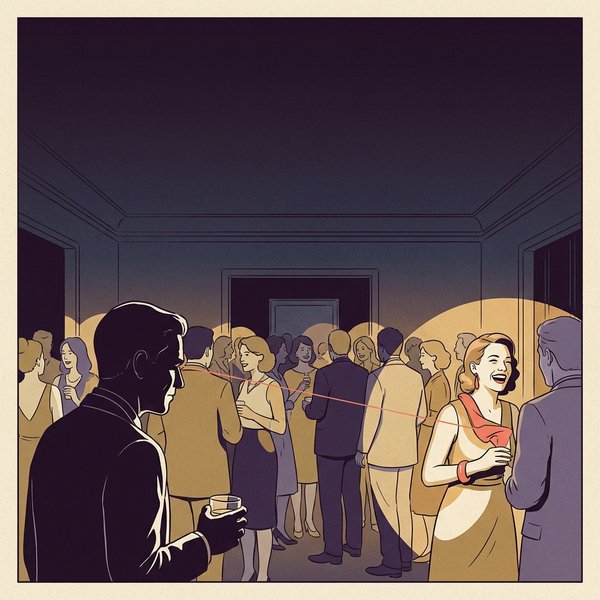 Sociosexuality.org · Audio Jealousy
Part 1 · 45 min What jealousy is
Part 2 · 46 min Jealousy in monogamy
Part 3 · 44 min Jealousy in open relationships
Jealousy: What It Really Is, Where It Comes From, and What Research Says About Handling It
+ VAT where applicable
Picture a Saturday night party.
Your partner is across the room, laughing with someone, and it's a real laugh, the leaning-in kind, and your chest goes tight before you've had any thought about it at all.
Or it might be later, back at home. They're telling you about their day and a name comes up, the same name as last week, and you hear yourself ask a question in a voice that doesn't quite sound like yours.
Or maybe you are in an open relationship. You agreed to this. You wanted this. You believe in it. And tonight your partner is out with someone else, and you are sitting on the edge of the bed, wondering why the feeling did not read the agreement.
Jealousy.
It doesn't care whether you're monogamous, open, or somewhere in between, it shows up anyway.
We see jealousy come up in the forums of every group we hear from, monogamous couples and open ones and people somewhere in between, and the rules differ a lot more than the feeling does.
And nearly everything people tell you about jealousy is a verdict. It means you love them, or it means you're insecure, or controlling, or not evolved enough for an open relationship. Some say it's natural so you should act on it. Others say it's toxic and you should crush it.
None of those verdicts does you any good on the edge of the bed.
What would actually help is knowing what the feeling is, where it comes from and why it fires when it does, plus what people who live with it, in every kind of relationship, have found about handling it.
Researchers have looked at this from a lot of angles: the evolutionary explanations and the attachment ones, the different kinds of jealousy, what sets it off in monogamous couples, and what studies of non-monogamous people find about living with it.
Almost nobody lays it out clearly. So we did.
What changes after you listen
After you listen, jealousy will stop being a verdict on you. It will become something you understand.
You will know the two main ways researchers explain jealousy. One is the evolutionary explanation, which asks why a feeling like this would exist in the first place, and the other is the attachment explanation, which gets at why it runs louder in some people, and in some moments, than in others.
You will also find out that jealousy isn't one single thing. There are different kinds of it, and once you can name the one you're feeling it gets a lot easier to decide what you want to do with it.
If you're monogamous, you'll come away understanding what tends to set jealousy off and what it does to trust between two people, which means you can bring it up and talk it through before it hardens into an accusation.
If you are in an open relationship, or thinking about one, you will hear what studies of non-monogamous people find about living with jealousy. Not a promise that it vanishes. An honest look at how people carry it.
And wherever you sit, you will be able to talk about jealousy, with a partner or with yourself, in calm words instead of loaded ones.
No shame. No side taken between monogamy and anything else. Just the research, laid out so you can use it.
Here is some of what you will find out
- Why something as uncomfortable as jealousy would even exist, and what the evolutionary explanation says about it (Part 1)
- What attachment research adds, and why jealousy can be a whisper in one person and a siren in someone else (Part 1)
- There are several kinds of jealousy, and which one you're feeling tonight makes a bigger difference than most people think (Part 1)
- What the 1992 research by Buss and colleagues on jealousy tells you about the feeling in your own chest (Part 1)
- Jealousy doesn't prove you love someone, and it doesn't prove something is wrong with you either (Part 1)
- How your attachment style can shape the way jealousy shows up in you, and what that tells you about yourself (Part 1)
- The things that set jealousy off in monogamous relationships, so you can spot them coming and not get ambushed when they show up (Part 2)
- How jealousy wears down the trust between two people, and what that means when you sit down for the next hard conversation (Part 2)
- How a jealous feeling is different from a jealous action, and why it matters that you keep the two apart (Part 2)
- How to tell your partner you felt jealous without it turning into a list of charges against them (Part 2)
- If you're the partner on the other end, here's what tends to be going on for the person who feels jealous, so you can answer them with less heat (Part 2)
- What we found in studies of non-monogamous people living with jealousy (Part 3)
- Feeling jealous in an open relationship doesn't on its own mean you chose wrong (Part 3)
- How people in non-monogamous relationships deal with jealousy day to day in the research, not just get told to get over it (Part 3)
- What couples in monogamous relationships could take from research on jealousy in open ones, and what open couples could take back from them (Parts 2 and 3)
- Why jealousy shows up in every kind of relationship forum, monogamous or open, and what that might be telling you about your own feeling
- Why telling yourself "just don't be jealous" doesn't get you very far as a plan, whatever shape your relationship takes
- How to have a calm talk about jealousy with your partner, whatever kind of relationship you're in
+ VAT where applicable
- 135 minutes of audio in 3 parts
- A printable PDF workbook
- Plays in your browser on any device, signed in
30-day money-back guarantee. If it is not for you, write to support within 30 days and you get every cent back.
What each part gives you
Part 1 · 45 minutes
What jealousy is
This part gets to the question sitting under all the others, which is what jealousy is in the first place. We walk you through the two main ways researchers explain it. The evolutionary explanation asks why humans would have a feeling like this at all, and the attachment explanation asks why it comes on more strongly in some people, and at some moments, than it does in others. After that we look at how jealousy comes in different kinds, which is why one word ends up covering experiences that feel very different from each other, and why putting a name to the kind you feel is a real step forward. You will also hear about the work Buss and colleagues published on jealousy in 1992. By the end the feeling should have a shape you can work with.
You walk away with
- The evolutionary explanation of why jealousy exists
- Why attachment makes it hit some people harder than others
- Jealousy has different kinds, and it helps to name yours.
- Jealousy doesn't prove you love someone, and it doesn't prove something's wrong with you either.
Part 2 · 46 minutes
Jealousy in monogamy
This part looks at jealousy inside monogamous relationships. We go through what tends to set it off, so that the next time it shows up it feels less like an ambush and more like something you recognise. From there we look at what jealousy does to trust between two people, and that matters whether you are the one feeling it or the one on the receiving end. You'll learn to tell the feeling apart from what you choose to do with it, and you'll get words for bringing jealousy up with a partner without it landing as an accusation. And if it's your partner who gets jealous, this helps you understand what is happening for them, so you can answer with some understanding rather than getting defensive. By the end you should have a clearer picture of jealousy and trust and the way the two connect.
You walk away with
- What sets jealousy off in monogamous relationships
- How jealousy affects trust
- How a jealous feeling differs from the things you do with it
- Words to raise jealousy without an accusation
Part 3 · 44 minutes
Jealousy in open relationships
This part turns to open relationships and other forms of consensual non-monogamy. You will hear what studies of non-monogamous people find about living with jealousy. Not a slogan from either side. An honest look at what researchers found when they studied people who chose this way of loving. If you are already open, it gives you research instead of forum folklore. If you are curious, it shows you what living with jealousy in an open relationship looks like before you decide anything. And if you are monogamous, you may find ideas worth borrowing too.
You walk away with
- What studies of non-monogamous people find about living with jealousy
- Feeling jealous in an open relationship doesn't mean you picked the wrong way to love.
- Research instead of forum folklore
- Ideas that carry over between monogamous and open relationships
This is for you if…
- You feel jealous and you'd like to understand what the feeling is about, not just fight it off.
- your partner gets jealous and you want to understand what is going on for them
- you're monogamous and jealousy keeps getting between you and your trust in each other
- you're in an open relationship or thinking about starting one, and you'd like to hear what the studies say about living with jealousy
- you want the evolutionary and attachment explanations of jealousy, clearly told
- You would rather read what the research says about jealousy than hear slogans about whether it is good or bad.
This is not for you if…
- you want us to tell you that feeling jealous means your partner must be doing something wrong
- you want a promise that your jealousy will go away
- you want us to decide for you whether monogamy or an open relationship is the right choice
- you'd rather skip research that gives monogamy and non-monogamy the same respect
- you're looking for a quick fix for a relationship that's in crisis right now
Why you can trust it
We built every part of this title on published research, and one piece of that foundation is the jealousy work Buss and his colleagues published in 1992.
We also draw on attachment research on jealousy, and on studies of jealousy in consensual non-monogamy, which look at how people in open relationships live with it day to day.
We don't pick a side between monogamy and non-monogamy, and we don't treat jealousy as a virtue or a sin either. When the research is strong we tell you so, and when it's limited we tell you that as well.
Built on the research: Buss and colleagues (1992); attachment research on jealousy; studies of jealousy in consensual non-monogamy.
The workbook that comes with it
The workbook is where the listening turns into knowing your own jealousy. Each part gets its key ideas on a single page, and after that come questions about your own life, with space for you to write your answers.
You can use it with a partner, too. You each write honestly about the same feeling, then you compare what you wrote, and that tends to open up a conversation that's a lot harder to start out loud.
+ VAT where applicable
- 135 minutes of audio in 3 parts
- A printable PDF workbook
- Plays in your browser on any device, signed in
30-day money-back guarantee. If it is not for you, write to support within 30 days and you get every cent back.
Questions you may have
I'm monogamous, so does the part on open relationships apply to me?
It can be. In Part 3 we look at what research on non-monogamous people has found about living with jealousy, and a fair bit of that carries over to monogamous relationships too. If it turns out not to be for you, Parts 1 and 2 work fine on their own.
You're in an open relationship and you still feel jealous. Does that mean you're not cut out for it?
We don't give you a yes or no on that here. Part 3 goes through what research has found about non-monogamous people who live with jealousy. That way you can look at your own feeling next to the studies, instead of measuring yourself against some ideal you think you should match.
Will this help me stop feeling jealous?
No, it won't do that. What you get is an understanding of where jealousy comes from, the different kinds of it, what tends to set it off, and what the research says about handling it. Once you understand a feeling, how you respond to it can change, even though the feeling itself still shows up now and then.
My partner is the one who gets jealous. Can this help me?
Yes, it can. Once you know what jealousy is and what tends to set it off, it gets easier to see what is going on for your partner. You can answer with more patience then, and the two of you can talk about trust without either one feeling attacked.
Does it stay with evolution, or does it get to my own relationship?
Both. In Part 1 we look at where jealousy comes from, and that covers the evolutionary explanation and the attachment one. Parts 2 and 3 take it into real relationships, monogamous and open, and go through what the research says about trust and about how people live with the feeling.
Does it pick a side between monogamy and open relationships?
No. Jealousy shows up in both kinds of relationship, and we treat both with the same respect here. We are not going to tell you that one way of loving beats the other.
Can we listen as a couple?
Yes. It tends to be easier to talk about jealousy once the two of you are using the same words for it, and the workbook gives each of you room to write down your own experience first, before you sit down and compare notes.
Does feeling jealous mean something has gone wrong in our relationship?
Not by itself, no. This title handles jealousy as a feeling that has explanations, different kinds and things that set it off, and it doesn't treat it as a verdict on the relationship. Part 2 goes into how it affects trust, which helps you sort out whether you're looking at a feeling to understand or a problem the two of you need to talk through.
How do I listen?
Once you've got your title, it sits in your library right here on the site, and you can play each part in the page itself on your phone, your tablet or your computer, so there's no app you need to install first.
Can I listen in the car, or when I'm out on a walk?
Yes. Open your library on your phone while signed in, and every part plays anywhere you've got a signal. It remembers where you stopped, so you can pause in the car and carry on later.
Do I need a password?
No. You sign in with the same email address you used when you bought, and we send a one-time link to that address so you can get in. You don't have a password to keep track of.
What is the workbook?
There's a PDF you can print to go along with the audio. It sets out the key ideas from each part, gives you questions to answer about your own life, and leaves space to write, either on paper or right on screen if you'd rather not print it.
Is this therapy, or medical advice?
No. It is education: the published research, explained clearly so you can use it. If you are in crisis or need care, a licensed professional is the right next step, and this can sit alongside that work.
What if it is not for me?
Then you get your money back. For 30 days after you buy a title, write to support and we refund you in full. You do not have to give a reason. A membership started at the 6-month price is covered too: the trial charge and the payment for its first months, for 30 days from the trial charge. The plain trial and the monthly membership are not covered by this guarantee.
My card was declined. What now?
Then the money was not taken from your card. Try again in a few minutes, or try another card. If it is declined again, your bank can tell you why: some banks turn down a first payment to a new shop until you say yes in their app. If it still does not go through, write to support and we will help.
So here's where that leaves us.
You have probably felt it already, the chest going tight, a voice coming out of you that doesn't sound like your own, sitting on the edge of the bed at midnight.
And maybe someone has told you what it says about you. That you love too much, or you don't trust enough, or you're not evolved enough yet, or you're just being controlling.
But the research tells a calmer story than that. Jealousy has explanations, and it comes in different kinds, with things that set it off and real effects on trust. Researchers have also looked at how people live with it, in monogamous relationships and in open ones too.
We think you have fought this feeling in the dark long enough, and three evenings or three long walks is roughly what it takes to hear what is really known about it.
You'll come out the other side with words for what you're feeling, a fairer read on a partner who feels it too, and a steadier way of handling it the next time it shows up.
That is what Jealousy: What It Is and How People Handle It was made for, and we hope you will give it a listen.
+ VAT where applicable
- 135 minutes of audio in 3 parts
- A printable PDF workbook
- Plays in your browser on any device, signed in
30-day money-back guarantee. If it is not for you, write to support within 30 days and you get every cent back.
P.S. Feeling jealous doesn't mean something is wrong with you, or with the two of you. It's a feeling that has explanations behind it, comes in different kinds and has triggers we know about, and people get it in monogamous relationships and open ones too. In this title we walk you through what it is and what the research says about living with it.