← The library Opening the sample... Get the first 9 minutes of Part 1 free, out of 89 minutes in the full title. It is the same recording. Enter your email and it starts playing right here. That link has expired, or we have already sent you a newer one. Enter your email and we will send you a fresh link. Check your inbox. We sent a link to . Tap it and the sample opens. Nothing there yet? Look in your spam or promotions folder, or send it again. You are in now. Refresh the page and start listening. 0:00 of --:-- This title is in your library. Every chapter is open: tap one and it plays there. Emotional Affairs and Micro-Cheating: Where Is the Line? Maybe you and your partner have argued over a friendship, or a message that came in late at night, or a 'like' that seemed to mean more than a like. This is the research on that exact argument. 30-day money-back guarantee. If it is not for you, write to support within 30 days and you get every cent back.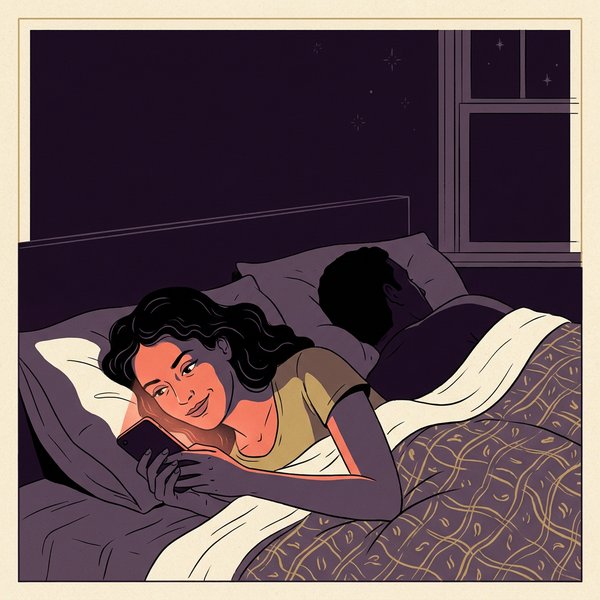 Sociosexuality.org · Audio Emotional Affairs and Micro-Cheating
Part 1 · 43 min Defining the line
Part 2 · 46 min Emotional affairs
Emotional affairs and micro-cheating: where the line is, and why the two of you put it in different places
+ VAT where applicable
It's eleven at night, and you're both on the sofa, sort of watching something.
Their phone lights up and they smile at it, then type something back and tip the screen a little away from you. It's a colleague, they tell you. Just a friend. Nothing happened, they say.
And you believe them. Most of the time, anyway. Nothing physical happened.
So why does it still feel like something did?
Or maybe you are the one with the phone. You have a friend you talk to every day. You tell them things. Good things, hard things. It feels like the most natural thing in the world, and you cannot understand why your partner goes silent every time the name comes up.
You call it a friendship, and your partner is watching something that feels a lot more like a slow betrayal.
The argument keeps circling back on itself, because the fight was not really about one message. It was about where the line sits, and it turns out the two of you had not agreed on that line to begin with.
Is it cheating if nobody touched anybody?
Is a secret conversation worse than a kiss at a party you both forgot about? Is following an ex online a small thing or a big deal? And where does being close stop and an emotional affair start?
You have probably heard the loud answers. If you have to hide it, it is cheating. Friendship is never cheating. Jealousy is just insecurity. Anyone who minds is controlling.
Trouble is, none of that settles it for the two of you.
Here is what almost nobody tells you. Researchers have studied how people define infidelity: what they count, what they do not, and why two partners can disagree about where the line sits. And work by Buss and colleagues from 1992 looked at two different kinds of jealousy, sexual and emotional.
There's actual research on the same fight you two keep having, and we went through it and laid it out so it's easy to follow.
What changes after you listen
Once you've listened, we think that argument about where the line is stops being a contest over who's right, and you start seeing it as two people who have each been using a different map of the same thing the whole time.
You will hear what the studies say about how people define cheating and why two partners can land in different places on it, which isn't a ruling on you or on them but a way to see where each of you is standing.
You'll finally have words for the thing that's hard to name, like why a closeness with no sex in it can still feel like a wound. And you'll see that sexual jealousy and emotional jealousy aren't the same feeling, and why it matters which one you're feeling.
You will learn how emotional affairs tend to start and what makes them different from a friendship, which gives you a fairer way to look at a friendship that worries you, and at one you are being asked to give up.
And you get a calmer way into a conversation that up to now has only ever opened as an accusation, or as somebody defending themselves.
We won't tell you where the line should be for you two, that part is yours to work out together. What we give you is the research, so whatever line you end up drawing, you draw it with your eyes open.
Here is some of what you will find out
- What the research says about how people define cheating, and the reasons you and your partner might not give the same answer (Part 1)
- Why two partners can read the very same message and both honestly come away seeing something different (Part 1)
- The reason the fight about "just a friend" keeps coming back is that it was never about the friend in the first place (Part 1)
- Where the research says people put the line between being close and cheating, and how two partners can end up putting that line in different spots (Part 1)
- The little things you might wave off as nothing and your partner keeps turning over in their head for days, what people call micro-cheating, and what the research on how people define infidelity says about it (Part 1)
- How "nothing physical happened" can be the honest truth and the conversation still isn't over (Part 1)
- What the 1992 research by Buss and colleagues on sexual and emotional jealousy can tell a couple who keep arguing about one particular friendship (Parts 1 and 2)
- Sexual jealousy and emotional jealousy feel like one thing but they are two different feelings, and when you are hurt it matters which of them is doing the talking (Parts 1 and 2)
- How to tell your partner where your line is, without it coming out as an accusation (Part 1)
- How emotional affairs usually start, step by small step, so you can spot the early ones for what they are (Part 2)
- How to tell a close friendship apart from an emotional affair, laid out clearly enough that you don't mistake a good friend for a threat (Part 2)
- Why an emotional affair can hurt as much as a physical one does, and why we think that hurt should be taken seriously (Part 2)
- If your partner wants you to drop a friendship, here is a fair way to look at what they might be afraid of (Part 2)
- If you're the one who got hurt: some words for a betrayal where there was no lipstick on anybody's collar (Part 2)
- Just because a friendship is close doesn't make it an emotional affair, and here's how you can look at the difference without getting worked up about it (Part 2)
- Why "jealousy is just insecurity" doesn't work as a rule for your relationship, and neither does "if you hide it, it's cheating"
- How to take a fight you keep having and turn it into one honest talk about what each of you actually counts as cheating
- Why where you draw the line is something the two of you decide together, and what the research can and can't add to that decision
+ VAT where applicable
- 89 minutes of audio in 2 parts
- A printable PDF workbook
- Plays in your browser on any device, signed in
30-day money-back guarantee. If it is not for you, write to support within 30 days and you get every cent back.
What each part gives you
Part 1 · 43 minutes
Defining the line
This part goes straight to the question that keeps coming back: where is the line? You will hear what studies find about how people define cheating, from the obvious to the small acts now called micro-cheating, and why two partners disagree about it. That disagreement is the heart of the matter. Once you see that you and your partner may simply be working from different definitions, the fight stops being about who is lying or who is unreasonable. It becomes a question you can answer together. You will also meet the idea that sexual and emotional jealousy are two different things, which helps explain why the same event can barely register with one of you and keep the other awake at night. By the end, you will understand your own line, and your partner's, far better.
You walk away with
- What the research finds about how people define cheating
- Why you and your partner put the line in different places
- Sexual jealousy and emotional jealousy are two different feelings
- Disagreeing about where the line sits doesn't prove your partner is lying to you.
Part 2 · 46 minutes
Emotional affairs
This part is about emotional affairs themselves: how they start, and what separates one from a close friendship. That difference cuts both ways, since it can help you spot a connection that is drifting somewhere it shouldn't, and it can also keep a good friendship from being treated as a threat when it isn't one. After that comes the hardest question, which is why an emotional affair can hurt as much as sex. You'll hear what the research says about it, and you may come away with words for a betrayal that left no physical trace. Maybe you were the one who got hurt, and this part takes that pain seriously. Or maybe the friendship is yours, in which case it helps you see what your partner is afraid of.
You walk away with
- How emotional affairs start
- How an emotional affair is different from a friendship
- Why an emotional affair can hurt as much as sex
- A fairer view of both partners' fears
This is for you if…
- You and your partner don't agree on what counts as cheating.
- a friendship, a private chat or something you do online has turned into the thing the two of you keep arguing about
- you've felt betrayed by something that never got physical, and you want to understand why it still hurts as much as it does
- you've got a close friend your partner sees differently than you do, and you'd like to get where they're coming from without having to give up your own view of it
- you want to know how an emotional affair starts, and how it's different from a friendship
- you'd rather understand what the research says than win the argument with your partner
This is not for you if…
- You want someone on the outside to rule on which one of you is right in your relationship.
- You're hoping for proof one way or the other on whether your partner is having an affair.
- You're after a fixed rulebook for what is and isn't allowed, one that works the same for every couple.
- you're looking for ways to monitor a partner or check up on them
- you're looking for a quick fix for a relationship that's in crisis right now
Why you can trust it
Nothing in this title is made up. It rests on published research, and one part of that is the work on how people define infidelity, meaning what they count as cheating and what they don't, and why two partners can see it differently.
The second strand comes from Buss and his colleagues, who in 1992 looked at sexual jealousy and emotional jealousy side by side, and it helps you see that the hurt from sex and the hurt from closeness are two different experiences, not one.
We won't pick a side between the partner who is worried and the partner who has the friendship, and we won't tell you where your line should be. When the research is strong we'll tell you that, and we'll also tell you when it's limited.
Built on the research: research on how people define infidelity; Buss and colleagues' 1992 work on sexual and emotional jealousy.
The workbook that comes with it
The workbook is where the listening becomes something you can talk about together. Each part gets one page with the key ideas on it, followed by questions about your own life and room to write your answers down.
Print it twice, one for each of you. You each fill in your own copy first without looking at the other one, and then you lay the two side by side and go through where your answers agree and where they don't, which tends to tell you more than having the same argument one more time.
+ VAT where applicable
- 89 minutes of audio in 2 parts
- A printable PDF workbook
- Plays in your browser on any device, signed in
30-day money-back guarantee. If it is not for you, write to support within 30 days and you get every cent back.
Questions you may have
Will this tell us if what happened counts as cheating?
Not as a ruling. It shows you how people define cheating and why partners disagree, so the two of you can work out where your own line sits. No outside voice can decide that for your relationship, and this title does not try.
My partner keeps telling me I'm just jealous. Is this going to show them they're wrong?
No, that isn't what it's for. What it does is help the two of you understand what the jealousy is reacting to, and that includes how sexual jealousy differs from emotional jealousy. The talk you have afterward can then be fair to you both instead of a win for one side.
I have a close friend and my partner can't stand it. Is this going to take my partner's side?
No. It takes friendship seriously too. Part 2 goes through how an emotional affair is different from a friendship, and that can help your partner look at your friendship more fairly while it helps you see what it is they're afraid of.
What is micro-cheating, and is it a real thing?
It's a popular name for the small things one partner thinks cross a line and the other thinks are harmless. This title comes at it through the research on how people define infidelity, so the two of you can talk it over without the label doing the arguing for you.
We have an open relationship. Will this still be useful to us?
Yes, it can be. Plenty of couples who have agreed to sex with other people still keep lines of their own, and closeness with someone else can still land as a breach. What this title covers, how those lines get drawn and why emotional connection can hurt, applies to you too.
Should we listen together or apart?
Either way is fine. If you listen apart first, each of you gets some room to react on your own before anyone's watching. Listening together means you both hear the same words at the same time. And you can each put your answers in the workbook before you compare notes.
Why would a 1992 study on jealousy matter when you're asking about an emotional affair?
Buss and colleagues looked at sexual jealousy and emotional jealousy as two different kinds. That distinction is a useful key to the question at the heart of Part 2: why closeness without sex can still hurt, and why the two of you may not react to the same thing in the same way.
We've been a couple for years now. Is it too late to start talking about where the line is?
No, it's not too late. Understanding how people define cheating, and why partners so often disagree on it, helps whether this first came up in month one or after years together. You never put the line into words before, and you can still do that now.
How do I listen?
Once you've got your title, it sits in your library right here on the site, and you can play each part in the page itself on your phone, your tablet or your computer, so there's no app you need to install first.
Can I listen in the car, or when I'm out on a walk?
Yes. Open your library on your phone while signed in, and every part plays anywhere you've got a signal. It remembers where you stopped, so you can pause in the car and carry on later.
Do I need a password?
No. You sign in with the same email address you used when you bought, and we send a one-time link to that address so you can get in. You don't have a password to keep track of.
What is the workbook?
There's a PDF you can print to go along with the audio. It sets out the key ideas from each part, gives you questions to answer about your own life, and leaves space to write, either on paper or right on screen if you'd rather not print it.
Is this therapy, or medical advice?
No. It is education: the published research, explained clearly so you can use it. If you are in crisis or need care, a licensed professional is the right next step, and this can sit alongside that work.
What if it is not for me?
Then you get your money back. For 30 days after you buy a title, write to support and we refund you in full. You do not have to give a reason. A membership started at the 6-month price is covered too: the trial charge and the payment for its first months, for 30 days from the trial charge. The plain trial and the monthly membership are not covered by this guarantee.
My card was declined. What now?
Then the money was not taken from your card. Try again in a few minutes, or try another card. If it is declined again, your bank can tell you why: some banks turn down a first payment to a new shop until you say yes in their app. If it still does not go through, write to support and we will help.
So this is where things stand for us.
You keep having a fight that is not really about a phone, or a friend, or a message. It is about a line. And the two of you have never sat down and found out where each of you draws it.
Is it cheating if nobody touched anybody?
The research won't give you one rule that works for every couple. What it gives you is better than that, because you get to understand why people draw the line where they do and why two partners can disagree about it. It also covers how an emotional affair starts, and why it can hurt as much as sex does.
Or you could stop going round on the same argument and give it two evenings, or a couple of long walks, to find out what the research has to say about it.
By the time you finish you'll both have words for what you're feeling, you'll see your partner's side more fairly than you do now, and you'll have a calmer starting point for the conversation you actually need to have.
That's why we made Emotional Affairs and Micro-Cheating, and we hope you'll give it a listen.
+ VAT where applicable
- 89 minutes of audio in 2 parts
- A printable PDF workbook
- Plays in your browser on any device, signed in
30-day money-back guarantee. If it is not for you, write to support within 30 days and you get every cent back.
P.S. If you and your partner don't agree on what counts as cheating, that doesn't have to mean one of you is being unreasonable, it may be that each of you is working from a different line. In this title we show you how people define that line, how an emotional affair differs from a friendship, and why closeness without sex can still hurt, so the two of you can draw your line together.